Richest Counties in Minnesota (2026)
by Kristen Carney
Updated: February 9, 2026
Richest County in Minnesota
The richest county in Minnesota is Carver County with an average household income of $159,987 as of 2024 and 110,041 people as of 2024 according to the most current Census data available (citation).
| Rank | County | Population | Average Income | Median Income |
|---|---|---|---|---|
| 1 | Carver County | 110,041 | $159,987 | $125,946 |
| 2 | Scott County | 154,557 | $149,625 | $119,314 |
| 3 | Washington County | 276,238 | $148,415 | $115,345 |
| 4 | Hennepin County | 1,269,496 | $138,433 | $97,653 |
| 5 | Olmsted County | 164,498 | $132,916 | $95,406 |
| 6 | Dakota County | 445,771 | $131,262 | $106,318 |
| 7 | Wright County | 148,269 | $126,718 | $107,209 |
| 8 | Sherburne County | 100,560 | $123,508 | $105,466 |
| 9 | Anoka County | 370,349 | $120,024 | $101,869 |
| 10 | Chisago County | 57,991 | $116,368 | $99,400 |
| 11 | Ramsey County | 542,945 | $112,592 | $81,568 |
| 12 | Nicollet County | 34,411 | $112,374 | $79,756 |
| 13 | Le Sueur County | 29,113 | $112,026 | $94,968 |
| 14 | Dodge County | 21,045 | $111,773 | $95,739 |
| 15 | Stevens County | 9,739 | $106,207 | $75,733 |
| 16 | Rice County | 67,917 | $104,276 | $83,181 |
| 17 | Wabasha County | 21,565 | $102,189 | $82,007 |
| 18 | Goodhue County | 47,943 | $102,161 | $84,171 |
| 19 | Houston County | 18,653 | $101,996 | $79,825 |
| 20 | Steele County | 37,439 | $101,587 | $84,196 |
Median Income versus Average Income: Which Should You Use?
We usually suggest using median income data – either instead of or in addition to – average income data as a true indicator of wealth. If you haven’t thought about median versus average since your last standardized test, you aren’t alone. Here’s what they are:
- average is the sum of a set of numbers divided by the count of numbers in the set
- median is the middle number in the set of numbers
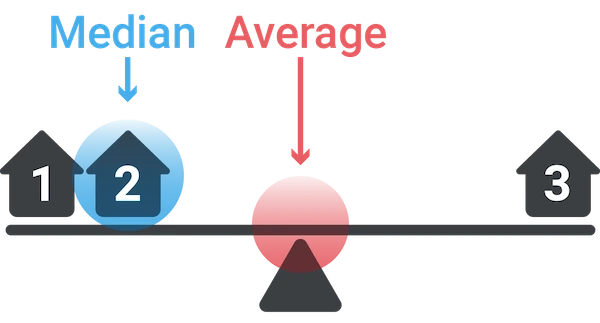
Now let’s say you had the following simplified set of income data.
Household 1: $30,000
Household 2: $50,000
Household 3: $1,000,000
The average income for this set is $360,000. The outlier data point ($1,000,000) skews the average WAY up. Conversely, the average income would be skewed WAY down if someone had an income of $500. The median income for the same data set is $50,000. Outlier data doesn’t skew the median.
Most Business Owners Should Use Median Income
So most business owners should use the median income as a true indicator of wealth, because it provides a more accurate representation of a typical income, especially in areas with significant income disparity.
When Should You Use Average Income
If your target market is high-income households, the average income may be more relevant. This is because the average income can highlight the presence of a higher concentration of wealthy individuals, which is beneficial for luxury goods and services marketing. We’re using average income on this page because using the Census’s highest reported median value of $250,001 could result in multiple ties for the richest geography.
Why do so many cities have a median value of $250,001?
The Census' American Community Survey uses $250,000+ as a jam value for median income estimates to protect privacy, ensure data consistency, and simplify reporting. A "jam value" in survey data refers to a placeholder or default value used when actual data points are unavailable, incomplete, or exceed certain thresholds. We represent this jam value as $250,001 to make it easy for you to sort.
You might also be interested in:
Email Me When New Data Are Released
Join thousands of subscribers and receive just 1 (ONE!) email a year in December when the US Census Bureau releases new income data for Minnesota richest counties.
SOURCES
United States Census Bureau. Annual Estimates of the Resident Population: April 1, 2020 to July 1, 2024. U.S. Census Bureau, Population Division. Web. May 2025. http://www.census.gov/.
United States Census Bureau. B01001 SEX BY AGE, 2024 American Community Survey 5-Year Estimates. U.S. Census Bureau, American Community Survey Office. Web. 29 January 2026. http://www.census.gov/.
United States Census Bureau. B19013 Median Household Income, 2024 American Community Survey 5-Year Estimates. U.S. Census Bureau, American Community Survey Office. Web. 29 January 2026. http://www.census.gov/.
United States Census Bureau. “DP03 SELECTED ECONOMIC CHARACTERISTICS.” 2024 American Community Survey 5-Year Estimates. U.S. Census Bureau, American Community Survey Office. Web. 29 January 2026. http://www.census.gov/.
Products & Services
Plumbing
Connect
- 1-800-939-2130
- Contact Us

© Copyright 2026 Cubit Planning, Inc.